| 1 | use super::{BackendCoordAndZ, Drawable, PointCollection}; |
| 2 | use crate::style::ShapeStyle; |
|---|
| 3 | use plotters_backend::{BackendCoord, DrawingBackend, DrawingErrorKind}; |
|---|
| 4 | |
|---|
| 5 | /** |
|---|
| 6 | Represents a cuboid, a six-faced solid. |
|---|
| 7 | |
|---|
| 8 | # Examples |
|---|
| 9 | |
|---|
| 10 | ``` |
|---|
| 11 | use plotters::prelude::*; |
|---|
| 12 | let drawing_area = SVGBackend::new("cuboid.svg" , (300, 200)).into_drawing_area(); |
|---|
| 13 | drawing_area.fill(&WHITE).unwrap(); |
|---|
| 14 | let mut chart_builder = ChartBuilder::on(&drawing_area); |
|---|
| 15 | let mut chart_context = chart_builder.margin(20).build_cartesian_3d(0.0..3.5, 0.0..2.5, 0.0..1.5).unwrap(); |
|---|
| 16 | chart_context.configure_axes().x_labels(4).y_labels(3).z_labels(2).draw().unwrap(); |
|---|
| 17 | let cubiod = Cubiod::new([(0.,0.,0.), (3.,2.,1.)], BLUE.mix(0.2), BLUE); |
|---|
| 18 | chart_context.draw_series(std::iter::once(cubiod)).unwrap(); |
|---|
| 19 | ``` |
|---|
| 20 | |
|---|
| 21 | The result is a semi-transparent cuboid with blue edges: |
|---|
| 22 | |
|---|
| 23 | 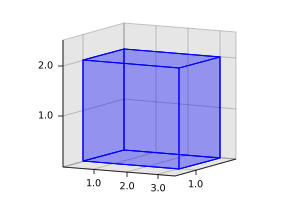 |
|---|
| 24 | */ |
|---|
| 25 | pub struct Cubiod<X, Y, Z> { |
|---|
| 26 | face_style: ShapeStyle, |
|---|
| 27 | edge_style: ShapeStyle, |
|---|
| 28 | vert: [(X, Y, Z); 8], |
|---|
| 29 | } |
|---|
| 30 | |
|---|
| 31 | impl<X: Clone, Y: Clone, Z: Clone> Cubiod<X, Y, Z> { |
|---|
| 32 | /** |
|---|
| 33 | Creates a cuboid. |
|---|
| 34 | |
|---|
| 35 | See [`Cubiod`] for more information and examples. |
|---|
| 36 | */ |
|---|
| 37 | #[allow (clippy::redundant_clone)] |
|---|
| 38 | pub fn new<FS: Into<ShapeStyle>, ES: Into<ShapeStyle>>( |
|---|
| 39 | [(x0, y0, z0), (x1, y1, z1)]: [(X, Y, Z); 2], |
|---|
| 40 | face_style: FS, |
|---|
| 41 | edge_style: ES, |
|---|
| 42 | ) -> Self { |
|---|
| 43 | Self { |
|---|
| 44 | face_style: face_style.into(), |
|---|
| 45 | edge_style: edge_style.into(), |
|---|
| 46 | vert: [ |
|---|
| 47 | (x0.clone(), y0.clone(), z0.clone()), |
|---|
| 48 | (x0.clone(), y0.clone(), z1.clone()), |
|---|
| 49 | (x0.clone(), y1.clone(), z0.clone()), |
|---|
| 50 | (x0.clone(), y1.clone(), z1.clone()), |
|---|
| 51 | (x1.clone(), y0.clone(), z0.clone()), |
|---|
| 52 | (x1.clone(), y0.clone(), z1.clone()), |
|---|
| 53 | (x1.clone(), y1.clone(), z0.clone()), |
|---|
| 54 | (x1.clone(), y1.clone(), z1.clone()), |
|---|
| 55 | ], |
|---|
| 56 | } |
|---|
| 57 | } |
|---|
| 58 | } |
|---|
| 59 | |
|---|
| 60 | impl<'a, X: 'a, Y: 'a, Z: 'a> PointCollection<'a, (X, Y, Z), BackendCoordAndZ> |
|---|
| 61 | for &'a Cubiod<X, Y, Z> |
|---|
| 62 | { |
|---|
| 63 | type Point = &'a (X, Y, Z); |
|---|
| 64 | type IntoIter = &'a [(X, Y, Z)]; |
|---|
| 65 | fn point_iter(self) -> Self::IntoIter { |
|---|
| 66 | &self.vert |
|---|
| 67 | } |
|---|
| 68 | } |
|---|
| 69 | |
|---|
| 70 | impl<X, Y, Z, DB: DrawingBackend> Drawable<DB, BackendCoordAndZ> for Cubiod<X, Y, Z> { |
|---|
| 71 | fn draw<I: Iterator<Item = (BackendCoord, i32)>>( |
|---|
| 72 | &self, |
|---|
| 73 | points: I, |
|---|
| 74 | backend: &mut DB, |
|---|
| 75 | _: (u32, u32), |
|---|
| 76 | ) -> Result<(), DrawingErrorKind<DB::ErrorType>> { |
|---|
| 77 | let vert: Vec<_> = points.collect(); |
|---|
| 78 | let mut polygon = vec![]; |
|---|
| 79 | for mask in [1, 2, 4].iter().cloned() { |
|---|
| 80 | let mask_a = if mask == 4 { 1 } else { mask * 2 }; |
|---|
| 81 | let mask_b = if mask == 1 { 4 } else { mask / 2 }; |
|---|
| 82 | let a = 0; |
|---|
| 83 | let b = a | mask_a; |
|---|
| 84 | let c = a | mask_a | mask_b; |
|---|
| 85 | let d = a | mask_b; |
|---|
| 86 | polygon.push([vert[a], vert[b], vert[c], vert[d]]); |
|---|
| 87 | polygon.push([ |
|---|
| 88 | vert[a | mask], |
|---|
| 89 | vert[b | mask], |
|---|
| 90 | vert[c | mask], |
|---|
| 91 | vert[d | mask], |
|---|
| 92 | ]); |
|---|
| 93 | } |
|---|
| 94 | polygon.sort_by_cached_key(|t| std::cmp::Reverse(t[0].1 + t[1].1 + t[2].1 + t[3].1)); |
|---|
| 95 | |
|---|
| 96 | for p in polygon { |
|---|
| 97 | backend.fill_polygon(p.iter().map(|(coord, _)| *coord), &self.face_style)?; |
|---|
| 98 | backend.draw_path( |
|---|
| 99 | p.iter() |
|---|
| 100 | .map(|(coord, _)| *coord) |
|---|
| 101 | .chain(std::iter::once(p[0].0)), |
|---|
| 102 | &self.edge_style, |
|---|
| 103 | )?; |
|---|
| 104 | } |
|---|
| 105 | |
|---|
| 106 | Ok(()) |
|---|
| 107 | } |
|---|
| 108 | } |
|---|
| 109 | |
|---|
